The Best Packable Travel Clothing for a Carry-On Only Trip
A carry-on packing guide covering fabric weight, wrinkle recovery, dry time, layering systems and laundry maths, with honest picks and their limits.
Top picks at a glance
Tap any pick to jump to the full breakdown, or use the link to check the current price.
| Pick | Best for | Check price |
|---|---|---|
| Patagonia Houdini Jacket Best packable layer | Wind, drizzle and variable temperatures where a full shell would be overkill | Check price |
| Icebreaker Merino 150 Tech Lite Short Sleeve Crewe Best multi-day shirt | Long trips with limited laundry, and hot climates where cotton gets heavy | Check price |
| ExOfficio Give-N-Go 2.0 Boxer Brief Best quick-dry underwear | Anyone travelling with three pairs of underwear for a two-week trip | Check price |
| Patagonia Nano Puff Jacket Best packable warm layer | Cool destinations with unpredictable weather, and as a layer under a shell | Check price |
| Columbia Silver Ridge Utility Convertible Pant Best travel trousers | Warm destinations and trips that mix walking with casual dining | Check price |
| The North Face Women's Aphrodite 2.0 Pants Best trousers for a city trip | City breaks where you want comfort without looking like a hiker | Check price |
Packing light is not about being disciplined. It is about owning the right fabric. Two people can pack the same number of items and end up with completely different bags, because one of them is carrying cotton that gets heavy when damp and the other is carrying wool that can be worn three days running.
The clothes in this guide are chosen for the properties that matter in a bag: dry time, wrinkle recovery, how many wears you get before a wash, and whether they look acceptable in more than one setting.
The properties that decide whether clothing is worth packing
1. Dry time after a sink wash
The single most useful number a product page never prints. If a garment takes more than about ten hours to dry in a hotel bathroom, you cannot count on washing it overnight, which means packing more of it. Merino and thin synthetics dry fastest. Cotton and heavy fleece are the slowest.
2. Odour resistance between washes
Most trips are limited by how many times a top can be worn rather than by how many tops you own. Merino wool absorbs odour compounds and releases them on washing, which is why it dominates travel clothing. Treated synthetics help but the finish fades. Cotton has no advantage here at all.
3. Wrinkle recovery
There is a difference between a fabric that does not crease and one that recovers from creasing. Stretch wovens usually crease under compression and then hang out overnight. Cotton poplin creases and stays creased. Knits rarely crease but stretch out of shape. Know which failure you can live with.
4. Packed volume and weight
An ultralight jacket that occupies the space of a paperback earns its place. A jacket that is slightly warmer but fills a third of the bag usually does not. Weight matters less than volume for carry-on travel, because you are limited by the bag rather than by what you can lift.
5. Versatility across settings
A garment that works in two contexts is worth two garments. Plain dark trousers work for walking and for dinner. Convertible pants do not, quite. Neutral colours layer with everything and show fewer marks.
What is not worth paying extra for
- Specialist antimicrobial finishes. They wash out and wool does the job better.
- Travel-specific branding. A plain merino tee does the same thing without the logo.
- Compression bags for knitwear. They save space and crush fibres that will not recover.
- Very light fabric for trousers. It creases more and shows wear sooner.
- A third pair of shoes. Shoes are the least compressible item in any bag.
The packing list that actually works
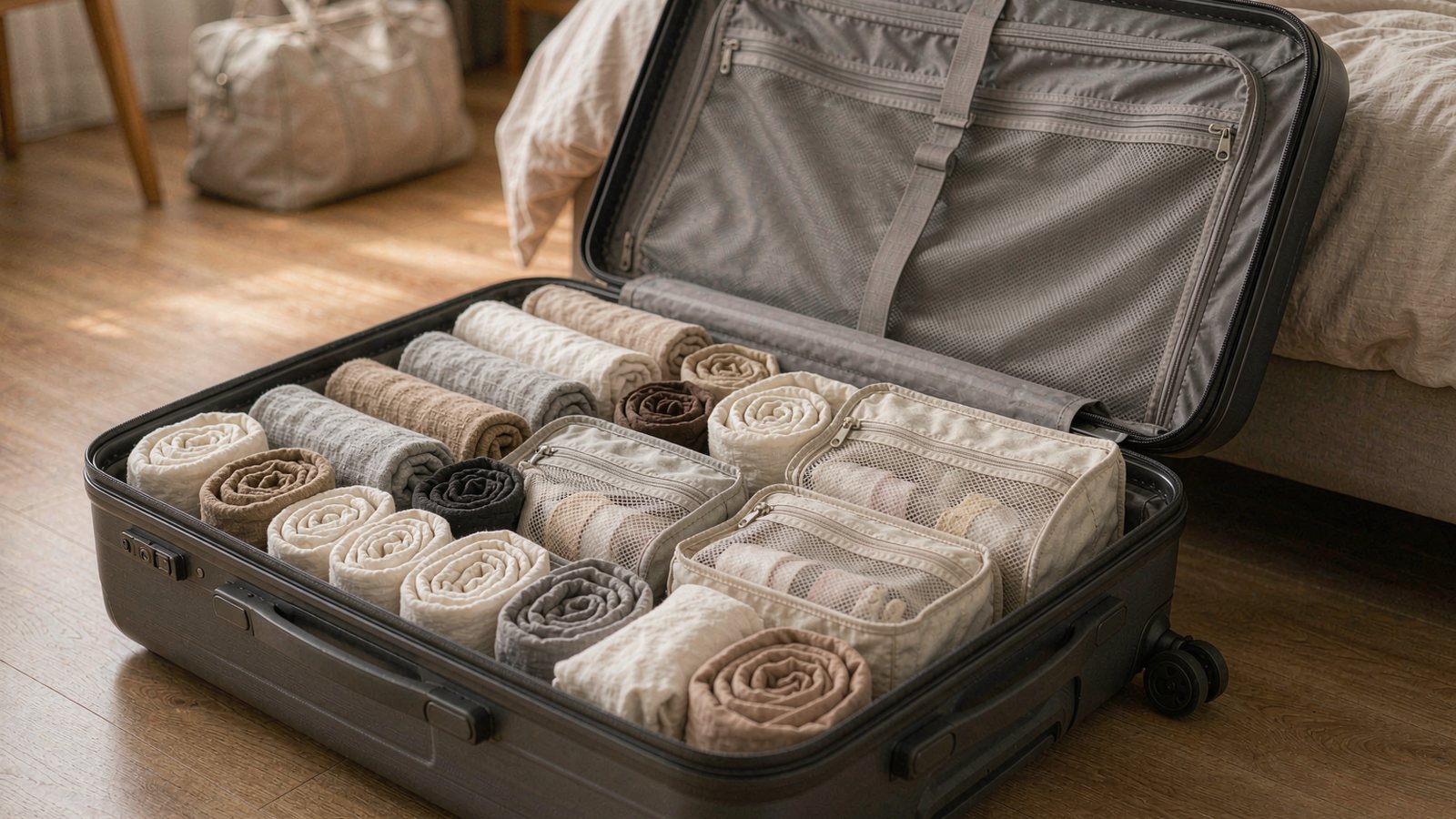
Two bottoms, five tops, one warm layer, one windshell, and enough underwear for five days with a wash on day three. Everything in a neutral palette so any combination works. Roll knits, fold wovens, and put the heaviest items at the bottom so the bag stands up on its own.
If that feels thin, the answer is almost always laundry rather than more clothing. One sink wash mid-trip removes about a third of the weight from a two-week bag.
How to choose in ten minutes
- Count the days and the laundry opportunities, not the outfits.
- Choose tops that survive three wears. Merino first, treated synthetic second.
- Choose bottoms that work in two settings and dry overnight.
- Add one warm layer that packs small and one windproof layer.
- Test pack once at home, then remove the item you hesitated over.
When the right answer is a checked bag
If the trip involves formal events, sports gear, or a climate with real extremes, a carry-on-only wardrobe is not worth the compromises. If you are travelling for work with a laptop, shoes and a suit, the maths rarely works without specialist garments. And if the airline charges less for a checked bag than you would spend on a merino shirt, paying the fee is the honest option.
How this guide was assembled
This guide is based on published fabric specifications, care instructions, drying guidelines and consistent themes in traveller reports about odour, packing volume and wrinkle recovery. We did not run timed drying tests. Travel gear is discounted unevenly and stock changes fast, so we link live listings and say check the current price instead of quoting a figure.
Our picks in detail
Patagonia
01 Patagonia Houdini Jacket
A featherweight windshell that packs into its own chest pocket and adds meaningful warmth over a mid layer. It is not waterproof enough for sustained rain.
Best for: Wind, drizzle and variable temperatures where a full shell would be overkill
- Ultralight ripstop nylon with a durable water repellent finish
- Packs into its own chest pocket
- Drawcord hood and hem
- Elasticated cuffs
Pros
- Adds warmth for almost no weight or space
- Dries within minutes if it gets wet
- Layers under a smarter jacket without bulk
Cons
- Not a rain jacket, despite the water repellent finish
- Very thin fabric that can snag on rough surfaces
We may earn a commission from this link. Learn more.
Icebreaker
02 Icebreaker Merino 150 Tech Lite Short Sleeve Crewe
A merino T-shirt you can wear three times between washes without it smelling or sagging, which is the single biggest packing advantage available. Fine merino needs gentler handling than cotton.
Best for: Long trips with limited laundry, and hot climates where cotton gets heavy
- Lightweight merino knit with a small amount of elastane
- Offset shoulder seams to reduce chafe under a pack
- Odour resistant by nature of the fibre
- Machine washable on a wool cycle
Pros
- Several wears between washes, which shrinks the packing list
- Regulates temperature in both warm and cool weather
- Dries overnight in a bathroom
Cons
- Pricier than a cotton tee and slower to dry than synthetics
- Needs cold washing and flat drying to avoid shrinkage
We may earn a commission from this link. Learn more.
ExOfficio
03 ExOfficio Give-N-Go 2.0 Boxer Brief
The classic travel underwear, designed to be washed in a sink and dry overnight. Synthetic fabric holds odour more than wool, which is the honest trade.
Best for: Anyone travelling with three pairs of underwear for a two-week trip
- Lightweight synthetic knit
- Odour-control treatment applied to the fabric
- Fast drying, typically overnight
- Elastic waistband with a flat profile
Pros
- Dries overnight after a sink wash
- Breathable mesh construction for hot climates
- Very compact when rolled
Cons
- Synthetic fabric retains odour more than merino
- Waistband elasticity is the first thing to fail over years
We may earn a commission from this link. Learn more.
Patagonia
04 Patagonia Nano Puff Jacket
A synthetic insulated jacket that stuffs small and keeps working if it gets damp, which makes it the better travel choice than down in wet climates. It is not as warm as down for the same packed size.
Best for: Cool destinations with unpredictable weather, and as a layer under a shell
- Synthetic insulation with a recycled polyester shell
- Packs into its own chest pocket
- Water-resistant shell with a durable water repellent finish
- Two zipped hand pockets
Pros
- Keeps insulating when damp, unlike down
- Springs back after being compressed in a bag
- Repairable through the brand
Cons
- Less warmth per gram than down
- Not warm enough alone in real winter
We may earn a commission from this link. Learn more.
Columbia
05 Columbia Silver Ridge Utility Convertible Pant
Pants that zip off into shorts and dry fast, which effectively doubles what a single garment covers. The zip line is visible and the styling is firmly outdoors, not smart.
Best for: Warm destinations and trips that mix walking with casual dining
- Lightweight synthetic fabric with a sun-protection rating
- Zip-off legs converting to shorts
- Multiple zipped pockets
- Quick drying and machine washable
Pros
- Covers two garments in one packing slot
- Dries fast after a hand wash
- Pockets are secure enough for a passport and phone
Cons
- Visible zip line at the thigh
- Looks like hiking clothing rather than city wear
We may earn a commission from this link. Learn more.
The North Face
06 The North Face Women's Aphrodite 2.0 Pants
Lightweight, stretchy trousers that look closer to normal clothing than technical pants, with a drawcord waist that travels well. The fabric is thin and creases easily if packed tightly.
Best for: City breaks where you want comfort without looking like a hiker
- Lightweight stretch woven fabric
- Drawcord waistband
- Zipped hand pockets
- Quick drying and wrinkle resistant
Pros
- Comfortable for long days of walking
- Passes as ordinary trousers in most settings
- Very light and packs flat
Cons
- Thin fabric shows creases when packed flat
- Limited structure, so it does not dress up
We may earn a commission from this link. Learn more.
The bottom line
Our verdict
For a carry-on trip, the single biggest saving is the Icebreaker merino tee, because wearing a shirt three times instead of once removes more weight from the bag than any other decision. Pair it with quick-dry underwear and one packable warm layer, and you have a system that survives a week without laundry. Take the Columbia convertible pants if the destination involves walking, and the Aphrodite pants if it involves restaurants. If you want one jacket, the Houdini handles wind and drizzle and the Nano Puff handles cold; between them they cover more conditions than any single piece. Check the current price, and check whether your airline's carry-on limit applies to the packed size rather than the listed volume.
Frequently asked questions
How many outfits do I actually need for a two-week carry-on trip?
Roughly five tops, two pairs of trousers and one warm layer, assuming you wash once. The limiting factor is how many times each item can be worn before it smells or looks dirty, which is why merino and quick-dry synthetics change the maths so dramatically. Fewer, better items beat more, cheaper ones.
Are wrinkle-resistant travel clothes worth the premium?
If you will attend a meeting or a dinner after a long flight, yes. The finishes reduce creasing but they fade with repeated washing, and the fabric usually feels less natural than untreated cotton or wool. Rolling clothes and unpacking immediately on arrival solves much of the same problem for free.
What is the best way to pack clothes so they crease less?
Roll knits and T-shirts rather than folding them, and use packing cubes to compress them. Fold woven shirts and trousers along existing seams and place them on top of the cubes, or in a garment folder. Heavier items go at the bottom so the bag stands up. Compression bags save space but crush fabrics that hold creases.
Is down or synthetic insulation better for travel?
Down packs smaller and is warmer for the weight, and it loses its loft if it gets wet. Synthetic insulation is bulkier but keeps working when damp and recovers faster from being compressed in a bag. For a wet destination or a trip where the jacket will be stuffed daily, synthetic is the safer choice.
Sources & further reading
- Patagonia — packable layers and product care information
- Icebreaker — official merino travel and care guide
- ExOfficio — official travel underwear fabric information
Facts and availability last checked September 15, 2026.
Keep going
Related guides
 Apparel
 Building a Plus-Size Basics Wardrobe That Actually Lasts
A practical guide to plus-size basics, covering pattern grading, fabric recovery, seam reinforcement and honest sizing charts, with picks at several budgets.
 Apparel
 The Best Sweaters That Don't Pill After Five Washes
We explain why knitwear pills and compare sweaters on fibre length, yarn ply, knit density and blend ratio, with honest caveats on each recommendation.
 Apparel
 The Best Loungewear Sets for Working From Home
We compared work-from-home loungewear on fabric weight, elastic recovery, waistband construction, opacity on video calls and how it holds up to constant washing.